

OUR FRESHWATER PEARLS
DAÏQUIRI was founded in Paris in 2022, out of a shared passion for pearls. A pearl takes years to form. Here is where pearls come from, how a freshwater cultured pearl is born, what it symbolises and how to keep it beautiful.
ORIGINS & SYMBOLS OF PEARLS
Pearls have fascinated people for millennia. According to the GIA, the Gemological Institute of America, the oldest written mention of pearls dates back to 2206 BC, in China. The ancient Chinese even believed they protected against fire and fire-breathing dragons.
Across cultures, pearls carry powerful symbols:
Purity. Their white glow evokes innocence and simplicity.
Calm & peace. Their soft light suggests serenity and inner balance.
Longevity & wisdom. In many traditions, the pearl stands for experience, intuition and maturity.
Pearl culture was born in China. As early as the 13th century, people there were growing “blister” pearls, attached to the shell of freshwater mussels. In Japan, Kokichi Mikimoto produced his first cultured pearls in 1893, after experiments in Ago Bay, in Ise-Shima. His first round pearls followed in 1905.
In 2025, our team travelled to Ise-Shima, now a national park, to discover Akoya pearls.
HOW A FRESHWATER PEARL IS BORN
In Ise-Shima, the Akoya pearl grows at sea, inside an oyster, around a shell bead. A freshwater pearl, on the other hand, grows in a mussel. Freshwater pearls are also called river pearls, even though they are mostly farmed in lakes and ponds.
It all starts with a graft. From a donor mussel, the grafter takes a strip of mantle, the tissue that makes nacre. It is cut into small squares, which are then slipped into the mantle of a host mussel: often a Hyriopsis cumingii, known as the “triangle mussel” for its shape. Around each piece, a tiny pouch forms, the pearl sac, which lays down nacre layer after layer.
The mussel then goes back into the water, usually for three to five years. With no bead at its heart, the pearl is made of nacre almost all the way through. It also grows a little as it pleases: round, oval, button or baroque. A perfectly round pearl remains the exception.

Some freshwater pearls are now grown around a bead, like Akoya pearls. They are still freshwater pearls: the GIA even warns against the name “freshwater Akoya”, which confuses buyers.
DID YOU KNOW?
An organic gem. A pearl is never mined: it grows inside a living mollusc. Yet the GIA counts it among gems. It is even one of the birthstones for June.
Not every pearl becomes jewellery. According to Gems & Gemology, the GIA’s journal, China harvested around 1,500 tonnes of freshwater cultured pearls in 2006. Only about 800 tonnes were suitable for jewellery.
Softer than you think. On the Mohs scale, which rates hardness from 1 to 10, pearl sits between 2.5 and 3. Diamond is a 10.
A pearl is, first and foremost, a matter of time and patience.
OUR PEARLS
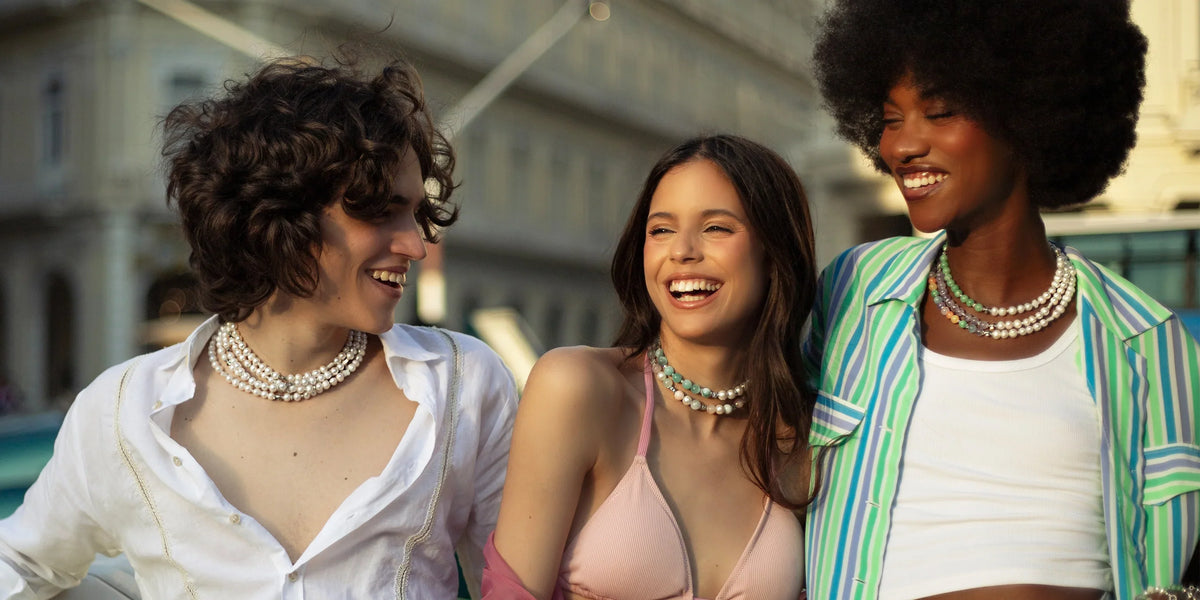
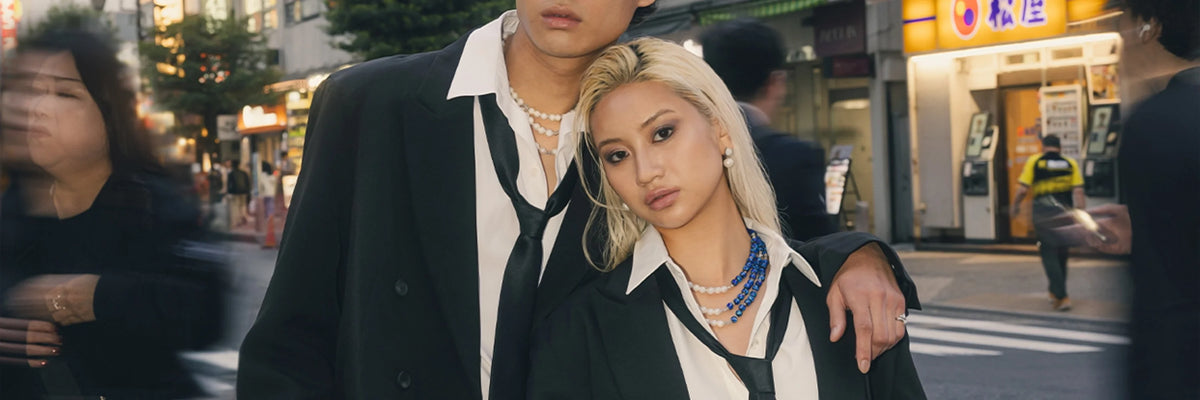
At DAÏQUIRI, everything starts with choosing the pearls. We use near-round, AA or AAA grade freshwater cultured pearls: 8 to 9 mm on our necklaces, 6 to 7 mm on our bracelets. Mostly white, they come in lilac, grey, pink or multicoloured in the SUNBURN collection. No imitation pearls.
We choose them one by one for their brilliance and the way they catch the light. None is a clone of its neighbour. A shape that strays slightly from round, a faint mark: to us, these are signs of authenticity, traces of their years inside the mussel.
You will find them on our pearl necklaces, assembled by hand in our ateliers in Paris. On the GLOW line, they team up with phosphorescent Hotaru beads, handmade Japanese glass beads that glow in the dark.

Real pearl or imitation, and at what price? Our answers are in Real pearls, real prices. For styling, by day and by night, here is how to wear a pearl necklace.
CARE RECOMMENDATIONS
A pearl is soft, and it does not like cosmetics. Four habits help it keep its lustre:
Last on. Put your jewellery on after creams and perfume, never before.
No sleep, no sport, no swim. Take it off to sleep, work out, shower or swim, and avoid knocks. The wire the pearls are strung on does not like liquids: if you do swim with your jewellery, rinse it in clear water afterwards.
Gently does it. If needed, wipe the pearls with a soft cloth dampened with clear water.
Apart. Store each piece in its DAÏQUIRI velvet pouch, away from harder objects that could scratch the nacre.

All the details, material by material, are on our Materials, Care & Warranty page.
A pearl took years to grow. It deserves a few seconds of care.
FREQUENTLY ASKED QUESTIONS
Freshwater pearl or river pearl: what is the difference?
None: they are two names for the same pearl, grown in a freshwater mussel. Despite the name “river pearl”, today’s freshwater cultured pearls mostly grow in lakes and ponds.
Is a freshwater pearl a cultured pearl?
At DAÏQUIRI, yes: all our freshwater pearls are cultured pearls. They grow inside a living mussel, after a graft made by a technician. A pearl that forms in the wild, with no human help at all, is another kind of pearl altogether.
What does a freshwater pearl symbolise?
People associate it with purity, calm and wisdom. In Europe, pearls long stood for modesty and chastity. For thousands of years, they have also been a sign of wealth. And the pearl is one of the birthstones for June.