




Article: OUR FINE STONES
OUR FINE STONES
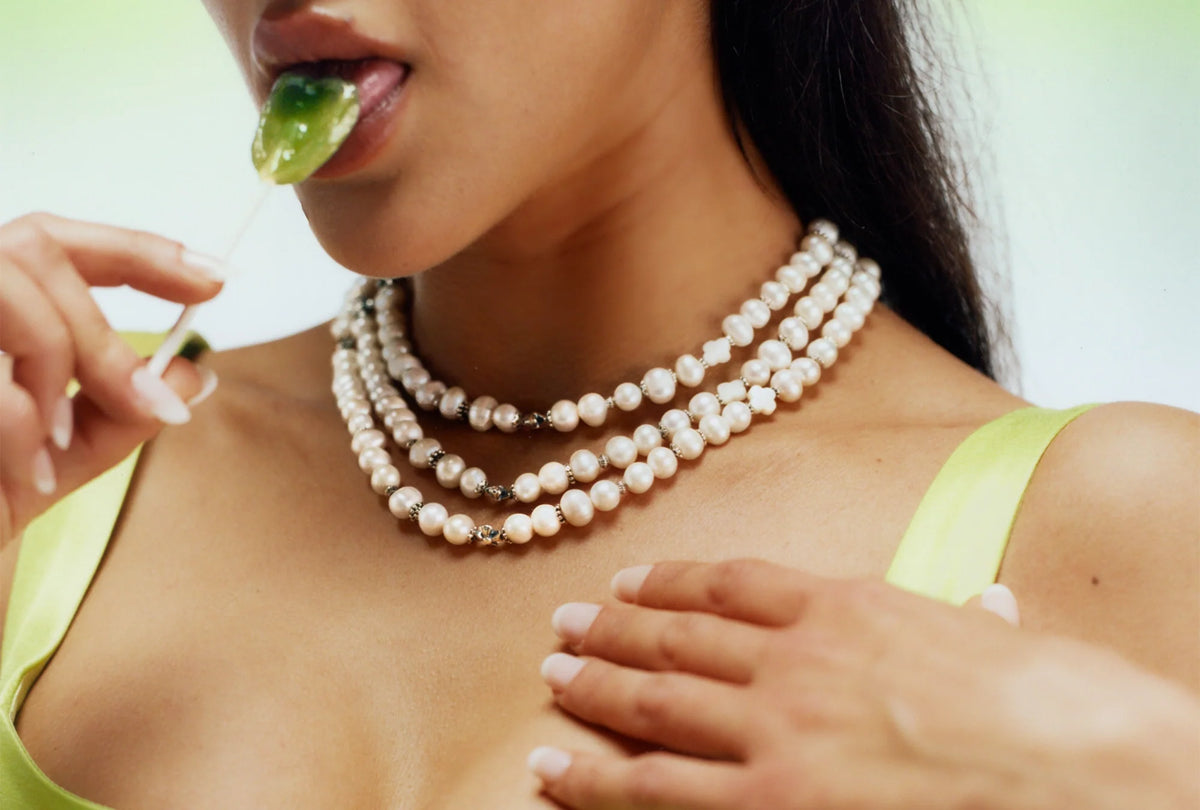
Ice, Mint, Basil: our colourways read like a cocktail menu. Behind each of these names lies a fine stone. On one side of the piece, freshwater cultured pearls. On the other, the stone that gives it its colour. That is how the two-tone necklaces and bracelets of our DAÏQUIRI ORIGINAL line are made, GLOW pieces aside.
Here is what our stones are, and what crystal healers credit them with. These virtues are a matter of belief, not science: we tell them as stories, never as promises.
CALL IT A FINE STONE
In France, a 2002 decree bans the word “semi-precious” from the gem and pearl trade. French jewellers say pierre fine instead: fine stone. The same text forbids calling an imitation or a synthetic stone “fine” or “natural”. At DAÏQUIRI, it is simple: no imitation stones. Pearls fall under the same decree, as our article real pearls, real prices explains.
As for care, our stones ask for very little: if needed, a soft cloth dampened with spring water.
SET SAIL
Ice – aquamarine blue. The word aquamarine comes from the Latin for “seawater”. Like emerald, aquamarine is a beryl, here in its blue version. In ancient times, sailors carried it as a charm against rough seas, to bring them safely home. It was also said to bless a marriage. It adorns the DAÏQUIRI ICE Necklace, a house best-seller, along with the matching bracelet and trousers chain, and the MIMOSA ICE Necklace, with its retro floral details.

Lagoon – turquoise blue. The word turquoise comes from the French for “Turkish stone”: the gem probably reached Europe through Turkey. It was worn by the rulers of ancient Egypt. It is said to bring good fortune and protection from evil. It forms one half of the heart on the HEARTBREAKER rings in LAGOON, and the hearts, spades, diamonds and clubs of the CASINO LAGOON rings.
Aqua – blue-green larimar. A variety of pectolite so far found only in the Dominican Republic. It colours the MIMOSA AQUA pieces.
GREEN ESCAPE
Pine – malachite green. A copper mineral, recognisable by its bands of soft and deep green. More than 5,000 years ago, in Egypt, people were already painting their eyes with it. Crystal healers see it as a stone of protection. You will find it on the DAÏQUIRI PINE Bracelet and on the CASINO and HEARTBREAKER PINE rings.

Basil – khaki-green jade. The word jade mainly covers two minerals, nephrite and jadeite. In China, where it has been worked for more than 3,000 years, it stands for clarity of mind and purity.
Mint – green angelite. The name says it all: crystal healers call it the angels’ stone. It brightens the DAÏQUIRI MINT Bracelet.
SOFT TOUCH
Lilac – lavender jade. Jade also comes in lavender, and that is the one in the Lilac. Crystal healers credit it with joie de vivre. Wear it as the DAÏQUIRI LILAC Bracelet, another house best-seller.

Candy – pastel morganite. Another beryl, a cousin of aquamarine, this time in pink. George Kunz, gemmologist at Tiffany & Co., named it after the banker J.P. Morgan. In crystal healing, it is a stone of tenderness. It gives the MIMOSA CANDY Bracelet its blush.
FADE TO BLACK
Coal – celestial-eye obsidian. Obsidian is a volcanic glass, most often black. It owes the name celestial eye to its sheen, which forms a pupil when the stone is polished into a sphere. For crystal healers, it is a stone of clairvoyance. With no pearls, just 925 silver, it makes up the DAÏQUIRI COAL Necklace and Bracelet.
On the HEARTBREAKER COAL rings, onyx, a variety of chalcedony, forms the black half of the heart. Mother-of-pearl forms the other, around a freshwater cultured pearl.

THE FIREFLY OF THE BUNCH
They light up in the dark, but they are not stones. Our Hotaru beads are Japanese glass beads, shaped by hand. Silver or gold leaf gives them their firefly glint: hotaru means firefly in Japanese. Phosphorescent particles make them glow at night.
People often search for them under the name Okinawa pearls: on the island, they are sold at almost every tourist spot. Their family is far older: the tonbo dama, the Japanese name for glass beads whose patterns recall a dragonfly’s eyes. In Japan, the earliest date from the 5th and 6th centuries. Their story is told in Hotaru beads, from Japan to Paris.

How to charge them and make them glow: it is all in our guide, glow in the dark, a user’s guide.
FREQUENTLY ASKED QUESTIONS
Which stone for which colourway?
Ice: aquamarine. Lagoon: turquoise. Aqua: larimar. Pine: malachite. Basil: khaki-green jade. Mint: angelite. Lilac: lavender jade. Candy: morganite. Coal: celestial-eye obsidian, or onyx on the HEARTBREAKER rings. Multi: a mix of aquamarine, jade, angelite, quartz and calcite. On our GLOW pieces, Ice, Lilac, Lagoon or Multi name the shade of the Hotaru beads, not a stone. Each product page lists what your piece is made of.
What virtues are Okinawa pearls said to have?
The name often refers to Hotaru beads, which are glass, not fine stones. At DAÏQUIRI, we see in them the calm of midnight blue and the energy of the fire that shaped them. Their only proven power: glowing in the dark.
Do cultured pearls have virtues?
Mostly symbols. According to the GIA, the Gemological Institute of America, pearls have traditionally stood for purity, humility and innocence, hence their place among wedding gifts. A cultured pearl is a real pearl: the same symbolism applies.