

Article: REAL PEARLS, REAL PRICES
REAL PEARLS, REAL PRICES
How much does a pearl necklace cost? It all depends on the pearls. In a photo, a cultured pearl and a plastic one look alike. Against your teeth, under a loupe or in the sun, far less so. Here is how to tell a real pearl from a fake, what sets its price, and what our necklaces cost.
CULTURED DOESN’T MEAN FAKE
A cultured pearl is a real pearl. It forms inside a living mollusc, like all pearls. People only get the process started: they slip in a piece of tissue or a bead, which the mollusc coats with nacre. For the history and symbolism of pearls, read our article on our freshwater pearls.
In France, these terms are defined by a decree of 14 January 2002. “Pearl” or “fine pearl”: a pearl formed with no human intervention at all, inside a wild mollusc. “Cultured pearl”: a pearl whose formation was triggered by people, inside a living mollusc. “Imitation pearl”: a man-made copy, without the properties of a pearl. Each must be sold under its own name.
At DAÏQUIRI, it’s simple: real freshwater cultured pearls, and no imitation pearls.
REAL OR FAKE?
Five simple checks give good clues. None of them is proof.
Against your teeth. Gently rub the pearl along the edge of your front teeth. A real pearl feels slightly gritty, like very fine sand: that is the nacre, made of tiny platelets. An imitation feels smooth. The catch: a polished pearl can feel smooth too, and some imitation coatings are made gritty on purpose.
Under a loupe. Pearls on the same strand are rarely identical twins: a slightly oval shape here, a small growth mark there. A strand where every pearl copies its neighbour should set alarm bells ringing. Under a jeweller’s loupe, an imitation looks grainy and glittery; a real pearl looks smoother.

At the drill hole. Look at the edge of the hole. On a real pearl, the nacre runs right up to the edge. On an imitation, the coating is often very thin: it chips, or shows a different material underneath.
In your hand. A plastic strand feels surprisingly light. Glass and coated shell, however, can weigh as much as pearls: this test is not enough on its own.
In the light. A pearl’s lustre comes from its layers of nacre: a sharp reflection with depth. An imitation often shines without that depth. The best ones can still fool you.

For certainty, you need a gemmology laboratory. It examines the inside of the pearl, with X-rays among other methods, and only a lab can say whether a pearl formed in the wild or was cultured. In Paris, the Laboratoire Français de Gemmologie tests pearls.
WHAT SETS THE PRICE
As with a diamond, quality sets the price of a pearl. The GIA, the Gemological Institute of America, judges pearls on seven factors: size, shape, colour, lustre, surface, nacre quality and how well the pearls match.
All else being equal, a larger pearl is rarer, so it costs more. Round, the hardest shape to culture, is generally the most valuable. Lustre may be the factor that matters most. The value of a colour follows supply and demand. A small mark often gives a real pearl away; numerous or deep marks bring its value down.
The type of pearl counts too. According to the GIA, freshwater cultured pearls are one of the jewellery world’s biggest bargains: each mollusc produces dozens, while others grow just one per shell. Saltwater pearls (Akoya, Tahitian or South Sea) generally cost far more. Then there is the piece itself: the metal, the clasp, the thread, and the hands that put it together.
CARDS ON THE TABLE
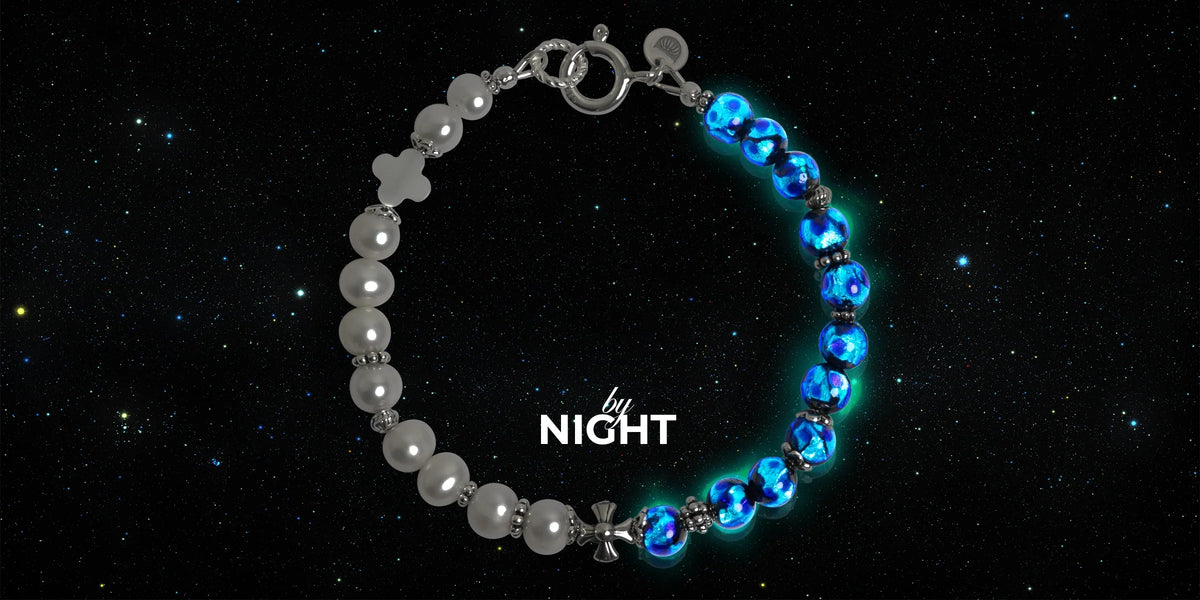
Our freshwater cultured pearl necklaces range from €135 to €395 depending on the style. The DAÏQUIRI TIMELESS Necklace, our best-seller, is €190. Most of our GLOW necklaces, with their phosphorescent Hotaru beads, are €250, and the limited-edition GLOW BLOOM pieces, with hand-painted Hotaru beads, are €260. The CASINO Necklace is €350, or €395 in gold-plated sterling silver. Each product page gives the exact price. Got a gift in mind? Our ideas by budget: pearl-perfect gifts.

What does that price cover? Freshwater cultured pearls of 8 to 9 mm on our necklaces, near-round, AA or AAA grade, chosen one by one for their lustre. Sterling silver or gold-tone findings. Mother-of-pearl, fine stones or Hotaru beads, depending on the style. Nylon-coated steel cable wire. The details are in our FAQ.
And hands. Every necklace is assembled by hand, to order, in our ateliers in Paris. Our first pieces were born in April 2022, in a small Parisian flat: that is our story.
Delivery within 48 hours in mainland France, free from €100. Returns within 14 days. Jewellery box included. Two-year legal guarantee. And 4.9/5 from 350+ reviews.
Real pearls, real prices. The rest is just gloss.
FREQUENTLY ASKED QUESTIONS
How much does a cultured pearl necklace cost?
It depends on the type of pearls, their size, shape and lustre, and on the piece itself. Freshwater cultured pearls are among the most affordable. At DAÏQUIRI, our necklaces, handmade in Paris, range from €135 to €395.
What is a pearl necklace worth?
Its value is judged on the GIA’s seven factors: size, shape, colour, lustre, surface, nacre and matching. For a family heirloom, only a gemmology laboratory can say for certain whether its pearls formed in the wild, were cultured or are imitations.
Is a cultured pearl a real pearl?
Yes. It forms inside a living mollusc, like all pearls; people only start the process. In France, it must be sold as a “cultured pearl”; a copy in glass or plastic, as an “imitation pearl”.