



HOTARU BEADS, FROM JAPAN TO PARIS
In Japan, they are called Hotaru beads. In France, many people know them as “Okinawa pearls”. The first comes from Japanese; the second, from the island that made them famous. We went there ourselves.
On the menu: a Japanese lesson, a family story, a stopover on the island, then on to Paris.
A LITTLE JAPANESE LESSON
Hotaru (蛍) means firefly in Japanese. In the character, you can spot the sign for insect, 虫. In Japan, the firefly is a symbol of summer: hotaru gari, firefly hunting, takes place at dusk, by the water.
Hotaru beads owe their name to their glint: under the glass, crumpled silver leaf catches the light and scatters it into a thousand sparkles, like a firefly above a stream.
What is a Hotaru bead at DAÏQUIRI? A Japanese glass bead, shaped by hand. Silver or gold leaf gives it its firefly glint, and phosphorescent particles make it glow in the dark. It is neither a stone nor a cultured pearl: at DAÏQUIRI, it keeps company with our freshwater cultured pearls.

A FAMILY AFFAIR
Before the firefly came the dragonfly. In Japan, decorated glass beads are called tonbo dama, “dragonfly beads”: their round patterns recall the insect’s compound eyes. The family goes back a long way: such beads first appeared in Egypt and Mesopotamia around 1500 BC. Having reached Japan by way of China, they are found there as early as the 5th and 6th centuries, among the grave goods of Kofun-period tombs.
The Hotaru bead is one variety of them; the Japanese also call it hotaru garasu, firefly glass. Shaped in a torch flame, it holds silver leaf beneath the glass. Some stop there and simply sparkle. Others are also given phosphorescent particles and light up in the dark: those are the ones we choose.
Japanese glass beadmaking is an ancestral craft, and the work is still done by hand: our Hotaru beads are shaped one by one.
STOPOVER IN OKINAWA
Why Okinawa? Because in this archipelago in the far south of Japan, Hotaru beads have become a well-known kind of glass jewellery. You cannot miss them: they are sold at almost every tourist spot.
Their classic colour: blue. The colour of the GLOW line’s best-seller, the DAÏQUIRI GLOW MIDNIGHT Necklace: midnight-blue Hotaru beads opposite freshwater cultured pearls, on sterling silver, at €250.
There, Hotaru beads also come in the colours of the sea. Ours have a palette of their own, developed with our glass artisans: from midnight blue to the lilac of the DAÏQUIRI GLOW LILAC Bracelet, at €150.

NEXT STOP, PARIS
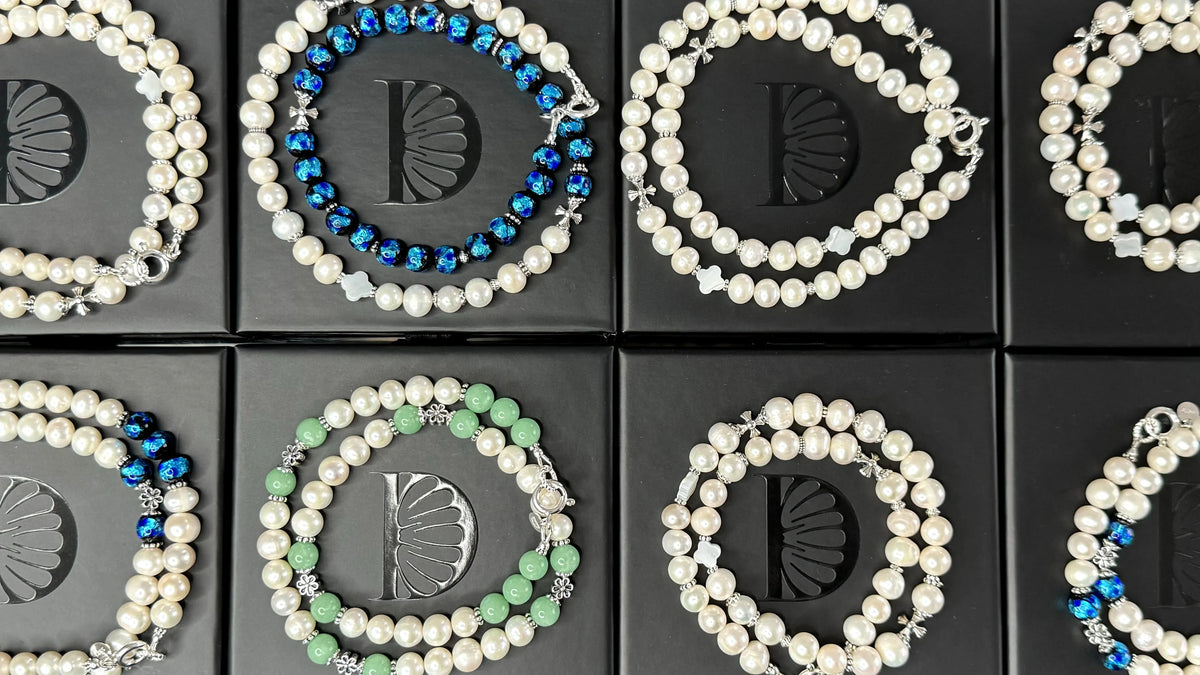
In our ateliers in Paris, each Hotaru bead joins our freshwater cultured pearls, and every piece in our GLOW line is assembled by hand. The pairing makes sense: the cultured pearl reflects the light, the Hotaru bead stores it, then gives it back in the dark. Our GLOW pieces are unisex and can be worn around the neck or on the wrist.
Genuine gold leaf lines the beads of the DAÏQUIRI GOLD GLOW SUN Bracelet, in gold PVD stainless steel, at €165, and those of the MIMOSA GOLD GLOW SUN. Silver leaf lines the beads of our other sterling silver GLOW pieces and those of the DAÏQUIRI GOLD GLOW MIDNIGHT, also in gold PVD stainless steel.
By day, our Hotaru beads fill up on light, from the sun or a lamp. As soon as the lights go out, they take over. To charge, wear and care for them, follow our guide glow in the dark: a user’s guide.
Every piece comes in its own jewellery box. A Japanese glass bead, strung in Paris, that switches on when you switch off: a gift that is bound to shine.

FREQUENTLY ASKED QUESTIONS
Why are Hotaru beads called “Okinawa pearls”?
Because in Okinawa you come across them everywhere: hardly a tourist site on the island goes without them. The name stuck: in France, “Okinawa pearls” usually means Hotaru beads, glass beads with silver leaf inside.
Do all Hotaru beads glow in the dark?
Not all of them. Their name comes first and foremost from the glint of the silver leaf under the glass, and only beads given phosphorescent particles light up in the dark. At DAÏQUIRI, all our Hotaru beads have them: it is the signature of the GLOW line. Daylight or lamplight is enough to charge them.
Is a Hotaru bead a stone?
No. It is a glass bead. The stones in our jewellery have an article of their own: our fine stones.